I'm so frustrated.
According to the data visualization on 91-DIVOC, cases in my state as of yesterday are at about the same level they were on April 1. Shouldn't we get to maybe like a pre-lockdown level of infection before we start reopening everything?
I saw this article yesterday about an "immediate 2nd peak" of infections. Of course! As things reopen, the virus is coming back, because no other steps have been taken to control it in the meantime. This article explains 5 goals states should meet in order to safely reopen - only 3 states met them.
The last 2.5 months have been totally wasted, except for allowing 100,000 Americans to die, and causing widespread economic damage.
Saturday, May 30, 2020
Friday, May 29, 2020
Homeward Bound
One week ago today I was in tears after talking to my COVID-19 positive relative, who had taken a turn for the worse and was in the hospital, struggling to breathe, halfway through treatment with an experimental antiviral drug.
Today, my husband and I cheered as they were released from the hospital, fully breathing on their own, talking and moving around without getting short of breath, and headed home to reunite with their spouse, who has also been sick.
What a crazy week of ups and downs this has been. I am so thankful for science, medicine, the brave and caring doctors and nurses who took care of them, and my family member's own strength and determined spirit 💕
Today, my husband and I cheered as they were released from the hospital, fully breathing on their own, talking and moving around without getting short of breath, and headed home to reunite with their spouse, who has also been sick.
What a crazy week of ups and downs this has been. I am so thankful for science, medicine, the brave and caring doctors and nurses who took care of them, and my family member's own strength and determined spirit 💕
 |
| A friendly EMT put on clean gloves and used my phone to take our picture together! |
It's not over - this disease does a number on your lungs and body, and it will probably be weeks or even months before they're feeling like themselves again. This virus is nothing to mess around with.
Thursday, May 28, 2020
No Mask, No Service
With many areas now starting the process of reopening some businesses to the public, the mask controversy is coming up again - do businesses have the right to refuse service to anyone not wearing a mask ... or to anyone who is wearing one?
I'm seeing a lot of people today sharing articles about businesses that are intentionally trying to be controversial by refusing to allow people in wearing masks. My first couple thoughts:
I'm seeing a lot of people today sharing articles about businesses that are intentionally trying to be controversial by refusing to allow people in wearing masks. My first couple thoughts:
- There's a lot of articles about this so it seems widespread, but it's probably a very small minority of businesses - this topic just makes a more exciting article than talking about all the people who are following recommendations and guidelines.
- This will make it easier to track where people may have picked up the virus (especially if multiple people get sick after visiting the same place) 🤷♀️
- Won't that business owner feel silly when people start suing them because they got sick in their establishment?
...Actually, since I started writing this post, I was looking at more of these articles, and it looks like all the recent ones are versions of the same story about a bar in Texas! So maybe this guy will go viral among the people who want to go viral, but it may be even less widespread than I originally thought!
Wednesday, May 27, 2020
What if you can't reopen?
 One of my biggest concerns regarding all the "reopening" is that for people who can't or don't want to reopen, there doesn't seem to be an option. What if you have a chronic disease or are otherwise at high risk of infection or serious complications from COVID-19? Or what if you live with or care for someone who is? If your business reopens and you are called back to work, can you just say, "No thanks, it's not safe for me yet," and continue collecting unemployment?
Someone I'm connected to on Facebook posted about this recently (claiming her daughter is a hairdresser clamoring to go back to work), and I shared these thoughts. She said that [in our state, at least] people can stay on unemployment if they're unable to return to work. That sounds like a good option. However, I haven't seen anything else written about that, and I've seen a lot written to the contrary, like the tweets here. If you're aware of an option to not return to work even if it reopens, please reassure me by leaving a comment!
Other arguments against reopening and relaxing restrictions right now? How about Coronavirus infections are rising as states reopen, potentially signaling a second wave? "New daily cases of COVID-19 — which have been falling for weeks, both nationally and in the hardest-hit metropolitan areas — suddenly and simultaneously started to rise in more than a dozen states. ... Most of the affected states were among the first to reopen in late April or early May ... One of [the conditions to reopen] was a 'downward trajectory of documented cases within a 14-day period.' Few if any of the early-to-open states met this benchmark. Then they reopened anyway."
Monday, May 25, 2020
No News is Good News
 As we near 100,000 COVID-19 deaths in the US, the New York Times put out what will surely become a historic and iconic front page (actually several pages) listing names and brief descriptions of over 1,000 victims. You can read the whole thing online. The story of how it came about is also interesting. The NYT has done front pages that were all graphics before, but never one that was all text. It's striking and heartbreaking.
In happier news, after a couple of really rough days, my family member with COVID-19 is sounding a lot better. There are definitely ups and downs throughout the day, but I talked to them on the phone today and they were sounding a lot better than they had been - they were up sitting in a chair, told me about the food they'd been eating, and had even used the restroom without getting too winded. They were still a little short of breath talking to me, but their oxygen had actually been turned down, after being increased a couple days ago. Today was their last dose of Remdesivir. They've only been using it at that hospital for a week, so aren't sure exactly when it takes effect, but from what I've read, it could shorten the duration of their illness by about a third. Their partner was also confirmed to be positive yesterday, but their symptoms aren't as bad and they didn't need oxygen, so were sent home to recover - someone from the hospital calls to check on them twice a day, and I and several other family members are lined up to call throughout the day as well.
I have three episodes of Mad Men left that I wanted to finish tonight so I could say I had finished by Memorial Day, but I may not have time, and also I don't want it to be over yet. What a great series.
 |
| "Time and Life" Season 7 Episode 11 |
Sunday, May 24, 2020
Mask Logic
For all the people who say we shouldn't wear masks/face coverings because they restrict your breathing and don't protect the wearer against viruses anyway:
1) If masks were so unbreathable, wouldn't people who wear masks for their job be passing out all the time? Why have we never heard of the numerous doctors, nurses, construction workers, nail technicians, or Asians with colds who are constantly being asphyxiated by their masks? Probably because you can breathe just fine. There have actually been many studies over the years to test this, and of course many more recently because it's been brought up again by the anti-mask contingent. See this Health article, or this piece from Snopes, with lots of good links and citations. Poynter, an independent organization specializing in media ethics, also has an article on this dangerous hoax, which is being seen globally.
2) If cloth masks kept you from breathing, they would also stop all viruses. Viruses are much larger than air particles. If you believe masks have a tight enough weave that they could prevent you from getting oxygen or releasing carbon dioxide, then you must also believe that they will keep out all viruses. Or, if you believe they're worthless because the weave is loose enough that they don't block viruses, then you must also believe that they allow for safe breathing.
3) You aren't wearing the mask to protect yourself. You're wearing it to protect others. While a cloth face covering doesn't keep out all contaminants, it does do a pretty good job of keeping them in. Coughing, sneezing, talking, or just breathing and existing cause you to expel potentially disease-carrying droplets. By wearing a mask, you can stop from spreading germs if you are unknowingly sick - which, with the long incubation period of COVID-19, you very well could be.

Caveat: There are some people who, for legitimate medical reasons, cannot wear a face mask, and that is ok. What's not ok is for healthy people who can wear masks not to wear them when required (e.g. by a store), citing the Americans with Disabilities Act (ADA) and Health Insurance Portability and Accountability Act (HIPAA). People who falsely claim a disability are not covered by the ADA, and since no medical records are being shared, HIPAA is not involved. Snopes has a good article on this viral claim.
1) If masks were so unbreathable, wouldn't people who wear masks for their job be passing out all the time? Why have we never heard of the numerous doctors, nurses, construction workers, nail technicians, or Asians with colds who are constantly being asphyxiated by their masks? Probably because you can breathe just fine. There have actually been many studies over the years to test this, and of course many more recently because it's been brought up again by the anti-mask contingent. See this Health article, or this piece from Snopes, with lots of good links and citations. Poynter, an independent organization specializing in media ethics, also has an article on this dangerous hoax, which is being seen globally.
2) If cloth masks kept you from breathing, they would also stop all viruses. Viruses are much larger than air particles. If you believe masks have a tight enough weave that they could prevent you from getting oxygen or releasing carbon dioxide, then you must also believe that they will keep out all viruses. Or, if you believe they're worthless because the weave is loose enough that they don't block viruses, then you must also believe that they allow for safe breathing.
3) You aren't wearing the mask to protect yourself. You're wearing it to protect others. While a cloth face covering doesn't keep out all contaminants, it does do a pretty good job of keeping them in. Coughing, sneezing, talking, or just breathing and existing cause you to expel potentially disease-carrying droplets. By wearing a mask, you can stop from spreading germs if you are unknowingly sick - which, with the long incubation period of COVID-19, you very well could be.

Caveat: There are some people who, for legitimate medical reasons, cannot wear a face mask, and that is ok. What's not ok is for healthy people who can wear masks not to wear them when required (e.g. by a store), citing the Americans with Disabilities Act (ADA) and Health Insurance Portability and Accountability Act (HIPAA). People who falsely claim a disability are not covered by the ADA, and since no medical records are being shared, HIPAA is not involved. Snopes has a good article on this viral claim.
Saturday, May 23, 2020
Day 3 Update
After the phone call I got yesterday from my COVID-19 positive family member, I was really upset - they sounded really bad, and said it was hard to talk, but they had no energy to text. However, they texted later in the afternoon after their second Remdesivir treatment, which they said went well. They said they were feeling a little better than earlier, but that it was "not a good day."
This morning I was awakened by a call from their spouse. They had texted early in the morning saying they'd had a bad night but were feeling a little better, and were turning off their phone. (That sounded very ominous - why couldn't the phone be left on and just ignored?)
But within a few hours, I got a text from them. They said they had a bad night and had to increase the oxygen they were getting. They were doing better by then, but still on higher oxygen, and talking takes too much energy. "No news today except hang in there and hopefully I start to turn the corner." And the good news was that they were feeling well enough to turn their phone on and send a message, and that every time we hear they haven't been doing well, it's followed by saying that they're doing better now.
This afternoon I got some really encouraging texts from them. (First of all, that they had enough energy to have a relatively lengthy text exchange was good news!) Their treatment today went well and they were feeling a little better. Their oxygen dropped to the 80s when they took it off to blow their nose, so they're being kept on the high flow oxygen for now, and O2 saturation is 97%. (This part is also encouraging, because some of the bad stories you hear are people who are getting lots of oxygen support but their saturation isn't improving.) The infectious disease doctor saw them today and reassured them they'll be ok but it will take a long time, it's not a 3 day disease. He said if he didn't think they'd be ok he would say so, this isn't something where you beat around the bush, and that made them feel better. It can be months before you feel normal, and they just watch and give oxygen support as needed. The only way to know you're improving is to need less oxygen. The doctor told them previously that this was all typical, so it doesn't sound like he's concerned that this is a particularly bad case or anything.
Today was day 3 of their 5 day Remdesivir treatment. I was reading about the study that was done on it and while it didn't make a huge difference, it did have best results in patients who needed oxygen but weren't on a ventilator (e.g. my family member), shortening recovery time by a few days and lowering the death rate slightly.
This morning I was awakened by a call from their spouse. They had texted early in the morning saying they'd had a bad night but were feeling a little better, and were turning off their phone. (That sounded very ominous - why couldn't the phone be left on and just ignored?)
But within a few hours, I got a text from them. They said they had a bad night and had to increase the oxygen they were getting. They were doing better by then, but still on higher oxygen, and talking takes too much energy. "No news today except hang in there and hopefully I start to turn the corner." And the good news was that they were feeling well enough to turn their phone on and send a message, and that every time we hear they haven't been doing well, it's followed by saying that they're doing better now.
This afternoon I got some really encouraging texts from them. (First of all, that they had enough energy to have a relatively lengthy text exchange was good news!) Their treatment today went well and they were feeling a little better. Their oxygen dropped to the 80s when they took it off to blow their nose, so they're being kept on the high flow oxygen for now, and O2 saturation is 97%. (This part is also encouraging, because some of the bad stories you hear are people who are getting lots of oxygen support but their saturation isn't improving.) The infectious disease doctor saw them today and reassured them they'll be ok but it will take a long time, it's not a 3 day disease. He said if he didn't think they'd be ok he would say so, this isn't something where you beat around the bush, and that made them feel better. It can be months before you feel normal, and they just watch and give oxygen support as needed. The only way to know you're improving is to need less oxygen. The doctor told them previously that this was all typical, so it doesn't sound like he's concerned that this is a particularly bad case or anything.
Today was day 3 of their 5 day Remdesivir treatment. I was reading about the study that was done on it and while it didn't make a huge difference, it did have best results in patients who needed oxygen but weren't on a ventilator (e.g. my family member), shortening recovery time by a few days and lowering the death rate slightly.
Vaccine Thoughts and Bioethics
I've mentioned here before that just having a viable vaccine is not going to be the solution to all the world's problems. First, they have to make enough of it. Then they have to distribute it all over the world, which could be challenging (for example, if it needs to be refrigerated, how do you transport it to places where that isn't possible). There's considerations about who should have access first: the country that invented it, the people most at risk due to other conditions, the people whose jobs put them in the most danger? And finally, you have to get people to take it - and I've seen articles claiming a quarter or a third of Americans say they won't. And they estimate that 70-85% of the population will have to be vaccinated to achieve herd immunity.
I also recently read this article stating a potential vaccine's power may be overestimated. Now, there are like 100 companies currently trying to develop a vaccine, and probably multiple options will end up coming to market. But there are different ways that vaccines work. For something like the measles vaccine, you get it and if it works right, you are protected forever. (Ok, there's a possibility you may need a booster of any vaccine at some point, but you shouldn't get "minor measles" from being "sort of" protected.) With the flu shot, scientists guess which strain of flu will be most prevalent that year and develop a vaccine for it; you still might get that strain or another one, but hopefully you will at least have a lesser infection than full-blown flu.
Some of the COVID-19 vaccines in development are looking more like the flu kind - they might not protect you from picking up the virus at all, but if you get sick, it will hopefully be a more minor illness. They're suggesting it may be more of an upper respiratory infection (like a regular cold) than a lower respiratory and multi-organ illness. They also found that the virus could still replicate, so even if a vaccinated person doesn't get sick themselves, they could still spread it to others.
Which brings me to the final article I wanted to share: a group of bioethicists have written an essay promoting the idea that protesters who deliberately disregard public health policy should forgo medical care if they do get sick. It's what people have been saying since the protests started, but now here is an official opinion on it. (Not that the protesters would actually do the moral thing by giving up treatment - if they were moral, they would have already been following the rules for the good of others. And meanwhile, medical professionals do follow a code of ethics that would require them to treat anyone, even if they weren't looking out for others.)
I also recently read this article stating a potential vaccine's power may be overestimated. Now, there are like 100 companies currently trying to develop a vaccine, and probably multiple options will end up coming to market. But there are different ways that vaccines work. For something like the measles vaccine, you get it and if it works right, you are protected forever. (Ok, there's a possibility you may need a booster of any vaccine at some point, but you shouldn't get "minor measles" from being "sort of" protected.) With the flu shot, scientists guess which strain of flu will be most prevalent that year and develop a vaccine for it; you still might get that strain or another one, but hopefully you will at least have a lesser infection than full-blown flu.
Some of the COVID-19 vaccines in development are looking more like the flu kind - they might not protect you from picking up the virus at all, but if you get sick, it will hopefully be a more minor illness. They're suggesting it may be more of an upper respiratory infection (like a regular cold) than a lower respiratory and multi-organ illness. They also found that the virus could still replicate, so even if a vaccinated person doesn't get sick themselves, they could still spread it to others.
Which brings me to the final article I wanted to share: a group of bioethicists have written an essay promoting the idea that protesters who deliberately disregard public health policy should forgo medical care if they do get sick. It's what people have been saying since the protests started, but now here is an official opinion on it. (Not that the protesters would actually do the moral thing by giving up treatment - if they were moral, they would have already been following the rules for the good of others. And meanwhile, medical professionals do follow a code of ethics that would require them to treat anyone, even if they weren't looking out for others.)
Farmers' Market
My local farmers' market just reopened a couple weeks ago. (This is normal - they have an indoor market over the winter that was cancelled, and then the summer market begins in May.) They have a lot of precautions in place, including:
There were a couple things we saw on the list from a local distillery this week that my husband wanted, so I went out at my designated 25 minute time slot this morning. Even with a mask on, the vendor recognized me, which was nice (we've spent a lot of time talking to him in past years). I was surprised that he handled my credit card, instead of asking me to swipe it. But he did go ahead and sign for me so I didn't have to touch his device. He said since our state closed liquor stores until recently, his business had actually been doing great! (I can confirm - my husband had already picked up orders from a couple other local distilleries during this time.)
Then I went back to my car, sanitized my hands, took of my mask, and wiped everything down when I got home.
The governor announced yesterday that all remaining counties in our state, including mine, will move from red to yellow phase in two weeks (and some of the boring ones are moving from yellow to green). I'm a little confused about this because my county is still at twice the amount of average new cases over the last 14 days that it's supposed to be to move to this phase. What's the point of setting science-based guidelines if you're going to be bullied into not following them?
 |
| This picture must have been from last week, today was rainy and gray |
- everyone must wear masks
- 1 shopper per household
- 25 minute time slot to shop, based on your last name
- 1 customer at a time per vendor booth
- everyone stays 6 feet apart
- vendors are encouraged to take pre-orders online if possible
- otherwise, they use "point to purchase" - customer points at something and vendor places it on a table for the customer to bag themselves
There were a couple things we saw on the list from a local distillery this week that my husband wanted, so I went out at my designated 25 minute time slot this morning. Even with a mask on, the vendor recognized me, which was nice (we've spent a lot of time talking to him in past years). I was surprised that he handled my credit card, instead of asking me to swipe it. But he did go ahead and sign for me so I didn't have to touch his device. He said since our state closed liquor stores until recently, his business had actually been doing great! (I can confirm - my husband had already picked up orders from a couple other local distilleries during this time.)
Then I went back to my car, sanitized my hands, took of my mask, and wiped everything down when I got home.
Friday, May 22, 2020
Weak
My infected family member had a first dose of Remdesivir yesterday. If there was going to be any bad reaction, it would happen right away, so they were monitored immediately after administering it. Nothing bad happened 🙌
I spoke to them on the phone this morning for the first time since they went into the hospital Wednesday. On Wednesday they sounded fine, but today they sounded so weak and tired, and kept coughing. They said this was the worst sickness they'd ever had. But the doctor told them this is how it typically is, so I guess whatever's happening is expected. They were too tired to reply to texts, and were barely able to speak without losing oxygen, but it was easier to call me and have me update everyone than to text back all the people who were checking on them.
Yesterday's updates were all very positive, but after hearing how they sounded today, I'm very concerned. Hopefully they just put all their energy toward healing. The next dose of medication will be this afternoon, and it's a five-day course of treatment.
I spoke to them on the phone this morning for the first time since they went into the hospital Wednesday. On Wednesday they sounded fine, but today they sounded so weak and tired, and kept coughing. They said this was the worst sickness they'd ever had. But the doctor told them this is how it typically is, so I guess whatever's happening is expected. They were too tired to reply to texts, and were barely able to speak without losing oxygen, but it was easier to call me and have me update everyone than to text back all the people who were checking on them.
Yesterday's updates were all very positive, but after hearing how they sounded today, I'm very concerned. Hopefully they just put all their energy toward healing. The next dose of medication will be this afternoon, and it's a five-day course of treatment.
Thursday, May 21, 2020
Interesting Articles
I've been sending these articles to my husband so I could save them for myself to post later. I'm not up to providing commentary, so just dumping them here...
About the Virus:
Prevention/Treatment:
Ending Lockdown:

About the Virus:
- T cells play a role in fighting coronavirus; COVID-19 affects children differently
- China’s New Outbreak Shows Signs the Virus Could Be Changing - “Chinese doctors are seeing the coronavirus manifest differently among patients in its new cluster of cases in the northeast region compared to the original outbreak in Wuhan, suggesting that the pathogen may be changing in unknown ways and complicating efforts to stamp it out. Patients found in the northern provinces of Jilin and Heilongjiang appear to carry the virus for a longer period of time and take longer to test negative.” Patients had >2 week incubation/asymptomatic period... making it harder for authorities to catch cases before they spread. “The longer period during which infected patients show no symptoms has created clusters of family infections.”
Prevention/Treatment:
- Moderna’s Coronavirus Vaccine Trial Shows ‘Positive’ Data: All 45 People Producing Antibodies
- Trump says he started taking hydroxycholoquine "a couple weeks ago" - "Here’s my evidence: I get a lot of positive calls about it.”
- Scientists in China believe new drug can stop pandemic "without vaccine"
- Woman who took Hydroxychloroquinine for 19 years for Lupus still got COVID-19 - "I'm like, 'How can I be sick? How? I'm on the hydroxychloroquine.' They were like, 'Well, nobody ever said that was the cure or that was going to keep you safe' and it definitely did not."
- Move Over, Moderna: Why Pfizer May Be the Better Bet to Deliver a Vaccine by Fall
Ending Lockdown:
- It's not safe to expand your quarantine circle just yet - “This is a public health problem. By not following those orders, you’re not just affecting you or your household, but you’re impacting your whole community, which includes those people who are at higher risk to develop serious complications.”
- Results of Europe's lockdown experiment
- Georgia defies prediction of coronavirus resurgence - "There could be fewer cases than before — but not as few as there would have been in lockdown. That’s only logical."

Wednesday, May 20, 2020
Positive
Today a close family member tested positive for COVID-19. They're probably the most socially distanced person I know right now. They have been out of their building twice in the last 2 months.
They had had a fever and chills for the past few days, and today checked their oxygen level, which was a little lower than normal, and heard what might be pneumonia in one of their lungs. (They recently retired from the medical field and had equipment on hand to do this.)
Because they are immunosuppressed, their doctor told them to go to the hospital for an x-ray and COVID-19 swab. Pneumonia was found in both of their lungs via a CAT scan (but wasn't visible in an x-ray) and their oxygen level was a little low. They are spending the night in the hospital with supplemental oxygen, and will meet with the infectious disease specialist tomorrow. They're considering treatment with an antiviral drug.
😡 Meanwhile, I have other family members who are mixing infants, senior citizens, people who have been in and out of medical facilities recently, and people who have had life-threatening health emergencies in the last few months. All hanging out indoors together. Wearing the same goggles on their faces. Sharing food. Totally disrespecting the sacrifices others are making right now. 😡
They had had a fever and chills for the past few days, and today checked their oxygen level, which was a little lower than normal, and heard what might be pneumonia in one of their lungs. (They recently retired from the medical field and had equipment on hand to do this.)
Because they are immunosuppressed, their doctor told them to go to the hospital for an x-ray and COVID-19 swab. Pneumonia was found in both of their lungs via a CAT scan (but wasn't visible in an x-ray) and their oxygen level was a little low. They are spending the night in the hospital with supplemental oxygen, and will meet with the infectious disease specialist tomorrow. They're considering treatment with an antiviral drug.
😡 Meanwhile, I have other family members who are mixing infants, senior citizens, people who have been in and out of medical facilities recently, and people who have had life-threatening health emergencies in the last few months. All hanging out indoors together. Wearing the same goggles on their faces. Sharing food. Totally disrespecting the sacrifices others are making right now. 😡
Monday, May 18, 2020
Out of the House
Today I was out of the house, by myself, for longer than I have been in months. We were told to use our vacation days, even though nobody's going anywhere, so I'm off work today.
First I picked up a curbside pickup order from a store. It's part of a gift 🤫
Then I went to my grandmother's house and vacuumed and cleaned for her. I wore a mask the whole time, wiped down everything I touched, and washed my hands throughout my time there. Meanwhile, she stayed up in a spare bedroom. Hopefully that was helpful to her. It was so weird being in there and not getting to see her 😢
Finally, I stopped for gas on my way home. I filled up my tank before all the lockdowns, and finally just almost hit half a tank over two months later. So I figured I should freshen it up, at least. I filled up my husband's car while we were out last week, so I had a system - basically I just don't touch anything with my bare hands, I used a disinfectant wipe to clean everything while I touch it, and then sanitizer when I'm done. And of course scrub everything once I'm home 😕
First I picked up a curbside pickup order from a store. It's part of a gift 🤫
Then I went to my grandmother's house and vacuumed and cleaned for her. I wore a mask the whole time, wiped down everything I touched, and washed my hands throughout my time there. Meanwhile, she stayed up in a spare bedroom. Hopefully that was helpful to her. It was so weird being in there and not getting to see her 😢
Finally, I stopped for gas on my way home. I filled up my tank before all the lockdowns, and finally just almost hit half a tank over two months later. So I figured I should freshen it up, at least. I filled up my husband's car while we were out last week, so I had a system - basically I just don't touch anything with my bare hands, I used a disinfectant wipe to clean everything while I touch it, and then sanitizer when I'm done. And of course scrub everything once I'm home 😕
Band Apart
Last night my band president announced that the board had decided to cancel all our summer performances. Not surprising - I think at this point we've all heard the story of the choir that had a major COVID-19 outbreak after rehearsing together. A wind band would be the same, with lots of forceful air and droplets being blown around, heavy breathing, and members in close proximity. Plus, many of our members and our audiences are at-risk populations like the elderly (heck, many of our venues are retirement homes; we even play twice a year at the veterans' center that is the site of a major outbreak and investigation in my county). I've written before about my concerns about band.
Anyway, I'm not surprised, I'm relieved. They're talking about finding a large rehearsal space for fall, and splitting the band into two smaller ensembles to practice. We can barely find a rehearsal space for us to all fit all crammed together now, so I don't know where we're going to find one that will allow for appropriate spacing of even half the band, especially considering the increased force of air blown through an instrument. And then would the two halves come together at the end for a concert..?
I actually had a dream/nightmare last night that we were playing a concert in the parking lot of my local township building (which we have never performed at before), and they had marks on the ground to space things out, but then I realized there were so many cars in the parking lot, there were still too many people. ...We're all going to be having really weird dreams for a long time to come, aren't we?
 |
| July 4th, 2019 concert |
I actually had a dream/nightmare last night that we were playing a concert in the parking lot of my local township building (which we have never performed at before), and they had marks on the ground to space things out, but then I realized there were so many cars in the parking lot, there were still too many people. ...We're all going to be having really weird dreams for a long time to come, aren't we?
Saturday, May 16, 2020
Excess Deaths
A friend of mine wrote about this on Facebook, and with his permission, I paraphrased it to share as a counterpoint to someone who claimed COVID-19 deaths are being over-counted. So I shall now post it here for posterity, because it's interesting and something I didn't really know about before.
In epidemiology, there's a metric called "excess death" - they take the average of the last 5-10 years of death records by week or month, and then they have a number of deaths they would expect in that week or month based on historical data. When there's an outbreak causing deaths, you can subtract the normal or "expected" deaths and get a figure called "excess death." It's how much more death we're seeing beyond the typical amount.
This is not necessarily due to the disease. For example, say there's a flood and it caused a cholera outbreak. The flood killed some people and cholera kills others, so epidemiologists will do their best to determine which are due to flood vs. disease. The ones due to the disease based on evidence are called "attributable deaths" - we know what likely caused them. The excess deaths number is a good way to measure, "Ok, if we have 300 flood deaths, and 180 cholera deaths, and 20 unknown, we could account for 500 excess deaths above usual."
For COVID-19, "excess deaths" spiked everywhere experiencing an outbreak, but again, not all caused directly by the disease. Some were people who died at home from something else because they were too worried to go to the hospital, and would have otherwise been preventable. So epidemiologists do the same thing: whoever tested positive for COVID-19, who has pneumonia, who showed symptoms (fever, cough, abnormal clots on autopsy - they're still learning all the signs of this new disease), should equal the excess deaths.
The problem is... they don't equal out like the flood example. There are a lot more excess deaths that have occurred and we don't know why this time. So when scientists say they think it's under reported, it could be because someone died at home and we don't know if they had symptoms beforehand, so they're not categorized. Right now there are a lot of these in areas where a lot of people have been dying of COVID-19 in the hospital. We can't necessarily prove they're COVID-19, and they didn't die of anything else obvious like a car crash, so we just don't know. They're things we suspect are COVID-19 related and later we might learn new things about the disease so we could say, "Oh, he died of a stroke, and we now know COVID-19 can trigger that."
The CDC has a chart with deaths attributable to COVID-19 and the excess deaths we don't know about (you can even filter it by state, and play with some of the other options). You can see there are more unattributable deaths right now, and this is what's led scientists to suspect that COVID-19 is actually being under-counted.
Two other recommended articles (these both require a free account to view):
In epidemiology, there's a metric called "excess death" - they take the average of the last 5-10 years of death records by week or month, and then they have a number of deaths they would expect in that week or month based on historical data. When there's an outbreak causing deaths, you can subtract the normal or "expected" deaths and get a figure called "excess death." It's how much more death we're seeing beyond the typical amount.
This is not necessarily due to the disease. For example, say there's a flood and it caused a cholera outbreak. The flood killed some people and cholera kills others, so epidemiologists will do their best to determine which are due to flood vs. disease. The ones due to the disease based on evidence are called "attributable deaths" - we know what likely caused them. The excess deaths number is a good way to measure, "Ok, if we have 300 flood deaths, and 180 cholera deaths, and 20 unknown, we could account for 500 excess deaths above usual."
For COVID-19, "excess deaths" spiked everywhere experiencing an outbreak, but again, not all caused directly by the disease. Some were people who died at home from something else because they were too worried to go to the hospital, and would have otherwise been preventable. So epidemiologists do the same thing: whoever tested positive for COVID-19, who has pneumonia, who showed symptoms (fever, cough, abnormal clots on autopsy - they're still learning all the signs of this new disease), should equal the excess deaths.
The problem is... they don't equal out like the flood example. There are a lot more excess deaths that have occurred and we don't know why this time. So when scientists say they think it's under reported, it could be because someone died at home and we don't know if they had symptoms beforehand, so they're not categorized. Right now there are a lot of these in areas where a lot of people have been dying of COVID-19 in the hospital. We can't necessarily prove they're COVID-19, and they didn't die of anything else obvious like a car crash, so we just don't know. They're things we suspect are COVID-19 related and later we might learn new things about the disease so we could say, "Oh, he died of a stroke, and we now know COVID-19 can trigger that."
The CDC has a chart with deaths attributable to COVID-19 and the excess deaths we don't know about (you can even filter it by state, and play with some of the other options). You can see there are more unattributable deaths right now, and this is what's led scientists to suspect that COVID-19 is actually being under-counted.
 |
| Excess Deaths Associated with COVID-19 "Excess deaths with and without COVID-19" dashboard for the United States |
Thursday, May 14, 2020
The New New Normal
With everyone getting so antsy about "reopening" and "getting back to normal," there's lots of planning being done to help people prepare for some sort of life outside their own home. It's not going to be exactly like it was before. It's not like the government will just flip a switch and say, "Ok, live like you were in February!" So consider if this is the type of environment really worth rushing back to.
In Denmark, they reopened schools earlier than many other things, because they have so many working parents. Classes are cut in half, students are spaced out in classrooms and only allowed to play with a small number of other kids in a small section of the playground. And they wash their hands about 6 times a day. (I don't see most schools in the US having the infrastructure to make this work, let alone kids going along with these rules.)
I was on a call today for work where they were talking about what our office would look like when it reopened. People will be issued a mask when they enter in the morning and have to wear it for the day. There will be hand sanitizing and cleaning wipe stations everywhere. "Sneeze guards" will protect people like the receptionists and computer help desk technicians. Marks on the floor will remind people to space appropriately. Elevators will have a capacity of one. Starting next week they're removing half the chairs from the conference rooms and marking spots on the floor to space out the remaining ones.
What's the point of all that? If you're going to have to operate in such a highly modified and potentially dangerous environment, why do it at all? Even I am starting to get a little tired of being home all day every day, but the alternative is so much worse, I really have no desire to go anywhere else.
The governor is supposed to be moving some more counties (the boring ones, at the other end of the state) from Red to Yellow status tomorrow. My corner of the state is still far from being ready (also I am mentally far from being ready). In order to move to yellow, a county needs to report fewer than 50 new reported cases over 14 days per 100,000 residents. The math is a little tricky, but my county is currently like six times higher than that. And I'm not a huge fan of doing it by county because I'm right on the corner of three counties, what if mine opens and people from one that's still closed come over here and reinfect everyone? It should be done more regionally somehow...
In other news, my husband went to his office today to pick up his desk chair - he was getting tired of spending so many hours working from our dining room table without it 😂 He's much more comfortable now!
In Denmark, they reopened schools earlier than many other things, because they have so many working parents. Classes are cut in half, students are spaced out in classrooms and only allowed to play with a small number of other kids in a small section of the playground. And they wash their hands about 6 times a day. (I don't see most schools in the US having the infrastructure to make this work, let alone kids going along with these rules.)
I was on a call today for work where they were talking about what our office would look like when it reopened. People will be issued a mask when they enter in the morning and have to wear it for the day. There will be hand sanitizing and cleaning wipe stations everywhere. "Sneeze guards" will protect people like the receptionists and computer help desk technicians. Marks on the floor will remind people to space appropriately. Elevators will have a capacity of one. Starting next week they're removing half the chairs from the conference rooms and marking spots on the floor to space out the remaining ones.
What's the point of all that? If you're going to have to operate in such a highly modified and potentially dangerous environment, why do it at all? Even I am starting to get a little tired of being home all day every day, but the alternative is so much worse, I really have no desire to go anywhere else.
The governor is supposed to be moving some more counties (the boring ones, at the other end of the state) from Red to Yellow status tomorrow. My corner of the state is still far from being ready (also I am mentally far from being ready). In order to move to yellow, a county needs to report fewer than 50 new reported cases over 14 days per 100,000 residents. The math is a little tricky, but my county is currently like six times higher than that. And I'm not a huge fan of doing it by county because I'm right on the corner of three counties, what if mine opens and people from one that's still closed come over here and reinfect everyone? It should be done more regionally somehow...
In other news, my husband went to his office today to pick up his desk chair - he was getting tired of spending so many hours working from our dining room table without it 😂 He's much more comfortable now!
Wednesday, May 13, 2020
Mask Wars
I'm so frustrated I don't even feel like writing this post, but I'm really trying to document everything, so here goes. In addition to everyone who's saying they prefer to wait in lines and crowds than vote by mail, there's also so many people (smart people! people who've worked in the pharmaceutical industry, even!) who are posting wrong and outdated information in an attempt to create controversy. Situations and recommendations are changing quickly, sometimes daily - that's one of the reasons I started this blog - and it's important to make sure you're referencing the latest information.
Last night someone shared an article on Facebook saying the CDC was recommending people don't wear masks. That obviously doesn't sound like current information, so I checked the article - it's from March 2nd. (I feel like publications should put a large disclaimer on these types of outdated articles, that may display in Facebook previews, to discourage this sort of thing.) Since the article was written during the time when they weren't recommending masks for the general public (due to concerns about sufficient PPE for medical providers, and worry that people would end up touching their faces more), I simply commented that this article is over two months old and the current recommendation is that people do wear masks to prevent the virus being spread by asymptomatic carriers.
Some woman I don't know started replying to me with further outdated screenshots stating that masks provide no protection and were not recommended. I responded with a current, active link to the CDC web site (one of several pages updated as of early April), where cloth face coverings are recommended. The other commenter kept saying things like, "They can't just change their minds," and that their previous statements were fact.
I didn't want to keep engaging, but I would have commented that political stance has changed on many things over the years, such as the right of women to vote, the right to marry someone of a different race or the same sex, heck, the right not to be a slave! Even the 18th amendment, prohibiting the production and sale of liquor, was overturned by the 21st amendment!
Instead, I said I was leaving my last comment because I didn't want to have an argument with a stranger, but the fact is that the CDC originally didn't recommend masks because 1) medical grade masks needed (and still need) to be reserved for medical professionals, and 2) at the time, the risk of accidentally touching your face while wearing the mask or wearing it incorrectly was greater than the risk of transmission via droplets/aerosol. As the situation has changed, their recommendation is now to wear some sort of face covering. It's more of a courtesy to keep others healthy than it is a protection for yourself. Unfortunately, because the guidance has changed frequently and isn't being modeled from the top down [e.g. the President and Vice President of the United States still refuse to wear masks], not everyone has gotten the message.
Wearing a mask does not make you scared, compliant, or complacent. It makes you considerate and responsible. The situation with the virus has gotten out of control, and so this is what it's now come to.

Last night someone shared an article on Facebook saying the CDC was recommending people don't wear masks. That obviously doesn't sound like current information, so I checked the article - it's from March 2nd. (I feel like publications should put a large disclaimer on these types of outdated articles, that may display in Facebook previews, to discourage this sort of thing.) Since the article was written during the time when they weren't recommending masks for the general public (due to concerns about sufficient PPE for medical providers, and worry that people would end up touching their faces more), I simply commented that this article is over two months old and the current recommendation is that people do wear masks to prevent the virus being spread by asymptomatic carriers.
Some woman I don't know started replying to me with further outdated screenshots stating that masks provide no protection and were not recommended. I responded with a current, active link to the CDC web site (one of several pages updated as of early April), where cloth face coverings are recommended. The other commenter kept saying things like, "They can't just change their minds," and that their previous statements were fact.
I didn't want to keep engaging, but I would have commented that political stance has changed on many things over the years, such as the right of women to vote, the right to marry someone of a different race or the same sex, heck, the right not to be a slave! Even the 18th amendment, prohibiting the production and sale of liquor, was overturned by the 21st amendment!
Instead, I said I was leaving my last comment because I didn't want to have an argument with a stranger, but the fact is that the CDC originally didn't recommend masks because 1) medical grade masks needed (and still need) to be reserved for medical professionals, and 2) at the time, the risk of accidentally touching your face while wearing the mask or wearing it incorrectly was greater than the risk of transmission via droplets/aerosol. As the situation has changed, their recommendation is now to wear some sort of face covering. It's more of a courtesy to keep others healthy than it is a protection for yourself. Unfortunately, because the guidance has changed frequently and isn't being modeled from the top down [e.g. the President and Vice President of the United States still refuse to wear masks], not everyone has gotten the message.
Wearing a mask does not make you scared, compliant, or complacent. It makes you considerate and responsible. The situation with the virus has gotten out of control, and so this is what it's now come to.

Monday, May 11, 2020
We Don't Know Anything
I've been saying this for a while, but WE 👏 DON'T 👏 KNOW 👏 ANYTHING 👏 ABOUT 👏 THIS 👏 VIRUS 👏 There is no way to say with certainty who is most likely to become infected, what happens to them, how they may recover, or what the long term effects will be months or years down the road.
This thing has been around for a matter of months. Most of that time has been spent putting out fires, not taking time to research it in a meaningful way. Yes, we have a lot of smart people and great technology that's enabled us to quickly map its genome and track it as it changes and spreads, but we really don't know much about how to fight it yet, and are discovering new things all the time.
I just read a couple of scary articles that made me totally lose my appetite for lunch. Doctors keep discovering new ways the coronavirus attacks the body, in the Washington Post, kind of rounds up all the latest symptoms that have been coming to light. This isn't just a respiratory disease, you might be able to breathe just fine and not have a fever, yet be dying from COVID-19. It affects all the systems of your body in a number of horrifying ways. And lest you think it's just a disease for the elderly, there's also new cases of children who are having different types of reactions. And even the adults who are dying aren't old and sickly and on their way out - a study found they could have expected to live another 10 years.
Finally, I also saw this article, Scientists concerned that coronavirus is adapting to humans. We've known for a while that there are different strains of the virus, and some of the changes may affect some of the elements that vaccines and other treatments are trying to target. The more it gets around, the more chances it has to mutate. The comments on this article are kind of horrifying, as expected, but there is one person who said, "the virus may mutate itself to extinction." (In this and his comments on some other articles he insinuates this is what happened with SARS.) Wouldn't that be nice..?
This thing has been around for a matter of months. Most of that time has been spent putting out fires, not taking time to research it in a meaningful way. Yes, we have a lot of smart people and great technology that's enabled us to quickly map its genome and track it as it changes and spreads, but we really don't know much about how to fight it yet, and are discovering new things all the time.
I just read a couple of scary articles that made me totally lose my appetite for lunch. Doctors keep discovering new ways the coronavirus attacks the body, in the Washington Post, kind of rounds up all the latest symptoms that have been coming to light. This isn't just a respiratory disease, you might be able to breathe just fine and not have a fever, yet be dying from COVID-19. It affects all the systems of your body in a number of horrifying ways. And lest you think it's just a disease for the elderly, there's also new cases of children who are having different types of reactions. And even the adults who are dying aren't old and sickly and on their way out - a study found they could have expected to live another 10 years.
Finally, I also saw this article, Scientists concerned that coronavirus is adapting to humans. We've known for a while that there are different strains of the virus, and some of the changes may affect some of the elements that vaccines and other treatments are trying to target. The more it gets around, the more chances it has to mutate. The comments on this article are kind of horrifying, as expected, but there is one person who said, "the virus may mutate itself to extinction." (In this and his comments on some other articles he insinuates this is what happened with SARS.) Wouldn't that be nice..?
Vote By Mail
I've started seeing a lot of people (smart people!) posting things like, "if you can wait in line at the supermarket, you can wait in line to vote," as opposed to using a mail-in ballot. But why?! For one thing, we shouldn't be aiming to congregate at either the supermarket or the polling place. And for another, there are many benefits to voting by mail, whether or not there's a pandemic going on. Several states vote by mail exclusively, and they're still running just fine. This Vox video explains it really nicely, but in case you don't want to watch, I've outlined the main concerns below:
Mail-in ballots are more likely to be used for fraud - Your ballot is tracked the entire time, from the time your request is approved, until it's sent to you, returned, and processed. And think of it this way: if someone does intercept your ballot and somehow tamper with it, they've changed one vote. If someone tampers with a voting machine at your polling place, they could potentially change all the votes cast there.
Your identity can't be verified when you vote by mail - In my state, you have to enter several pieces of personal identification to request your ballot. When you return it, your signature is compared to the signature on file in the roll book. Meanwhile, when you vote in person, a poll worker compares your signature to the one on file and that's it. This wasn't really covered in the video, but I feel like there's more verification that goes into the mail-in ballots than in-person voting.
Voting by mail benefits one party over the other - An April 2020 study by Stanford found that there's no benefit to either party. All mail-in voting does is increase the total number of people who vote (by more than double, in an example from Nebraska used in this video!)
We don't have the infrastructure for mail-in voting - All states already have absentee ballots, and many have optional mail-in voting. We would just need to prepare and scale up capacity for sending and processing these ballots.
What happens if you don't get your ballot - All the states that have mail-in voting also have in-person voting as a backup if a voter didn't receive their ballot or didn't register in time. And in all states, if you haven't returned your mail-in or absentee ballot, you can turn it in on election day and vote at your polling place.
People don't want to vote by mail - An April 2020 Harvard-Harris poll found that 72% of Americans are in favor of holding this year's presidential election by mail.
Besides these, there's also the benefit of convenience. You don't have to worry about taking time away from work, waiting in line, or feeling rushed to make a decision between people you might not be familiar with. You can take your time, research, and vote when it's convenient for you, without making a special trip anywhere but your mailbox.
My state just started allowing voting by mail without a reason this year, and I requested my mail-in ballot in mid-March, well before everyone started recommending it for safety. I don't see why everyone else wouldn't want that safety and convenience, too.
Mail-in ballots are more likely to be used for fraud - Your ballot is tracked the entire time, from the time your request is approved, until it's sent to you, returned, and processed. And think of it this way: if someone does intercept your ballot and somehow tamper with it, they've changed one vote. If someone tampers with a voting machine at your polling place, they could potentially change all the votes cast there.
Your identity can't be verified when you vote by mail - In my state, you have to enter several pieces of personal identification to request your ballot. When you return it, your signature is compared to the signature on file in the roll book. Meanwhile, when you vote in person, a poll worker compares your signature to the one on file and that's it. This wasn't really covered in the video, but I feel like there's more verification that goes into the mail-in ballots than in-person voting.
Voting by mail benefits one party over the other - An April 2020 study by Stanford found that there's no benefit to either party. All mail-in voting does is increase the total number of people who vote (by more than double, in an example from Nebraska used in this video!)
We don't have the infrastructure for mail-in voting - All states already have absentee ballots, and many have optional mail-in voting. We would just need to prepare and scale up capacity for sending and processing these ballots.
What happens if you don't get your ballot - All the states that have mail-in voting also have in-person voting as a backup if a voter didn't receive their ballot or didn't register in time. And in all states, if you haven't returned your mail-in or absentee ballot, you can turn it in on election day and vote at your polling place.
People don't want to vote by mail - An April 2020 Harvard-Harris poll found that 72% of Americans are in favor of holding this year's presidential election by mail.
Besides these, there's also the benefit of convenience. You don't have to worry about taking time away from work, waiting in line, or feeling rushed to make a decision between people you might not be familiar with. You can take your time, research, and vote when it's convenient for you, without making a special trip anywhere but your mailbox.
My state just started allowing voting by mail without a reason this year, and I requested my mail-in ballot in mid-March, well before everyone started recommending it for safety. I don't see why everyone else wouldn't want that safety and convenience, too.
Wasted Time
Remember a couple months ago when we were all talking about flattening the curve? That was just to buy us time, so hospitals didn't get overwhelmed, etc. That wasn't the end goal. We should have been using that time to prepare and develop a plan to help contain and reduce the virus. How are those plans going?
Supplies: Despite many manufacturers switching over to make masks and gowns, we still seem to have dire shortages of actual medical-grade protective gear. Some companies started making ventilators, but are they really as important and foolproof a treatment for people with COVID-19 as we were led to believe? Either way, the president has the power to compel US companies to do things like this, and so far, he hasn't really used it. Meanwhile, supply chains and overseas manufacturing are still struggling to catch up from the global shut down.
Treatment: There's not really a great treatment for people who do get infected. Some drugs are showing promise, but they're not an easy or guaranteed solution, and everything is still being researched. COVID-19 has only been around for a few months, and we don't know enough about it to say with certainty who it affects, in what ways, and how best to mitigate that.
Testing and Tracing: We've done almost nothing to increase testing capacity and contact tracing capabilities. Experts are suggesting that nationwide, we should be conducting between 500,000 to 5 million tests daily, depending on who's report you're reading. At the low end, this is several times more than is being done today; at the high end, it's hundreds of times more. As far as contact tracing, public health officials recommend an army of hundreds of thousands of individuals to handle this. As of now, there's a couple thousand, and not in every state. Plus, there are a lot of technology solutions being developed (e.g. apps that anonymously track what phones your phone is near, and whether those phones' owners have been infected), but I don't think a lot of people are going to be into that, for privacy reasons (even though it's anonymous).
Guidance: There has been zero clear guidance at a national level regarding how to safely "reopen" the country. This leaves states, counties, businesses, and individuals to figure out what might be best for them. While some places may have precautions in place, frustrated people and businesses are flagrantly violating their guidelines.
With multiple people now infected at the most inner levels of the White House, it's pretty clear that not even one of the most secure places in the world is safe from this virus - what chance do regular people and businesses have with no guidance or support?
Oh, and one more thing...
Vaccines: Lots of people are talking about getting by "until there's a vaccine." I've written before about vaccine development and how that process usually works. Although this is an exciting time, with hundreds of companies working on many promising candidates and lots of usual delays and red tape being removed to speed progress, this is still going to be a long time coming. Some drugs just started human trials - you'll still want time to make sure they are safe and effective, before giving them to a bunch of people. Once that's determined, it will take time to manufacture, distribute, and administer to enough people globally to confer herd immunity. And remember the anti-vaxxers? If they're against vaccines that have been in use for years for diseases like measles and polio due to safety concerns, what do you think would be their opinion of something that came to market relatively quickly? They already think it's going to contain Bill Gates' tracking microchips or something...
Supplies: Despite many manufacturers switching over to make masks and gowns, we still seem to have dire shortages of actual medical-grade protective gear. Some companies started making ventilators, but are they really as important and foolproof a treatment for people with COVID-19 as we were led to believe? Either way, the president has the power to compel US companies to do things like this, and so far, he hasn't really used it. Meanwhile, supply chains and overseas manufacturing are still struggling to catch up from the global shut down.
Treatment: There's not really a great treatment for people who do get infected. Some drugs are showing promise, but they're not an easy or guaranteed solution, and everything is still being researched. COVID-19 has only been around for a few months, and we don't know enough about it to say with certainty who it affects, in what ways, and how best to mitigate that.
Testing and Tracing: We've done almost nothing to increase testing capacity and contact tracing capabilities. Experts are suggesting that nationwide, we should be conducting between 500,000 to 5 million tests daily, depending on who's report you're reading. At the low end, this is several times more than is being done today; at the high end, it's hundreds of times more. As far as contact tracing, public health officials recommend an army of hundreds of thousands of individuals to handle this. As of now, there's a couple thousand, and not in every state. Plus, there are a lot of technology solutions being developed (e.g. apps that anonymously track what phones your phone is near, and whether those phones' owners have been infected), but I don't think a lot of people are going to be into that, for privacy reasons (even though it's anonymous).
Guidance: There has been zero clear guidance at a national level regarding how to safely "reopen" the country. This leaves states, counties, businesses, and individuals to figure out what might be best for them. While some places may have precautions in place, frustrated people and businesses are flagrantly violating their guidelines.
 |
| Eric DaSilva says this is Ramsay One Custom Flooring in Simi Valley, CA |
Oh, and one more thing...
Vaccines: Lots of people are talking about getting by "until there's a vaccine." I've written before about vaccine development and how that process usually works. Although this is an exciting time, with hundreds of companies working on many promising candidates and lots of usual delays and red tape being removed to speed progress, this is still going to be a long time coming. Some drugs just started human trials - you'll still want time to make sure they are safe and effective, before giving them to a bunch of people. Once that's determined, it will take time to manufacture, distribute, and administer to enough people globally to confer herd immunity. And remember the anti-vaxxers? If they're against vaccines that have been in use for years for diseases like measles and polio due to safety concerns, what do you think would be their opinion of something that came to market relatively quickly? They already think it's going to contain Bill Gates' tracking microchips or something...
Saturday, May 9, 2020
Some Thoughts
 Right now, more Americans are dying daily than in the 9/11 attacks. After 9/11, there was outrage and memorials and an all-out war against terrorism with changes to our daily lives that have been in place for almost 20 years. Where is that response now?
This week, we passed the number of American deaths from COVID-19 than there were deaths during the entire Vietnam War. Throughout that time, people protested the war, and went to great lengths to avoid being sent to fight. There are memorials to those who fought and lost their lives in Vietnam. Where is that response now that we have had the equivalent number of losses in just a couple months?
We are now at Great Depression levels of unemployment. During the Depression, government programs were put in place to feed and employ Americans; many aspects of the "social safety net" got their start during this time and are still in use today. Why aren't people calling for the government to support them while keeping them safe, instead of protesting for the "right" to be able to go back to work and put themselves and others in harm's way?
Friday, May 8, 2020
Catching Up
Updates from the past week:
- I've been trying to drive my car every few days to keep the battery from dying again.
- We had our driveway re-sealed. I assumed it would just be one guy, but it turns out he was working with a partner, neither of them had a mask, and I'm pretty sure they also weren't keeping 6 feet apart 🙈 (I've always been at work when it was done in past years, so I'd never seen how they do it before...)
- Last Saturday I went to visit my grandmom. Like last time, I stood on her front porch; but this time, she put a chair by her front door and we talked through the glass, so I could hear her better and didn't need to call on the phone. My uncle is the one designated person who goes in her house for groceries, but I wish I could go in and help her with things, like vacuuming or cleaning her bathroom. It might come to the point where I lock her in a bedroom, wear a mask, clean her house, and sanitize behind me on the way out.
- On Thursday I saw my mother for the first time in two months. She was out of the house for only the second time herself, and stopped by so I could put her Mothers' Day gift in the back of the car. We talked a little while she sat in the car and I stood 6 feet away, both with masks on.
- On Tuesday we celebrated Cinco de Mayo with a special fajita meal offered by a local Mexican place. They were good, but the stress of having to decant the food from its take-out containers and sanitize everything reminded me why this was only the second time we've ordered food.
- I also got three different grocery deliveries:
- Imperfect Foods, which was great as usual, except I was supposed to get a can of tomatoes and ended up with two jars of marinara sauce. But one of the items available this week was cheese and cracker trays that were overstock from an airline - it's exciting to see the system working in this way to reduce food waste!
- A delivery from Costco I ordered through the personal shopper app Dumpling - this connects you with an independent shopper who visits multiple stores for their clients and sets their own pricing rate, unlike Instacart or similar services that connect you with a random person each time you order. The service was fantastic, she asked about making substitutions, and almost everything I ordered was available. I've already recommended this shopper to others in my area, she was great and very professional.
- A pick-up order from the regular grocery store today - still didn't get everything I'd ordered, but I received most of it, including some things I haven't been able to find for a while. (I'm beginning to doubt rotini pasta exists in this country any longer, though 😂)
- My employer changed their vacation policy for this year: since nobody is taking vacation time right now, they're allowing us to carry over 10 unused days instead of the usual 5. We were supposed to go on vacation in a couple weeks, and I've cancelled all but two days, giving myself a long weekend. They will also be sending us reusable fabric masks, which is very nice of them, and my site is sending everyone a gift (we had four to choose from) to use at home.
- I'm very close to my goal of finishing "Mad Men" during lockdown. As of today, I have 1 season + 3 episodes left. I couldn't imagine trying to stretch this over the course of years watching live - it's such a well-constructed show, and I feel like you appreciate it more when you take it in all at once.
 |
| This week's Imperfect Foods delivery |
Doing the Hard Thing
Yesterday our governor added a few more counties to the "yellow" phase of our red/yellow/green system. More of the ones in the corner where nobody lives 😂 For the rest of us, he extended our stay-at-home order until June 4th.
I'm seeing more and more people say we can't live like this, we need to get the government officials making these decisions out of power, etc. And I know people who were strongly adhering to the orders before are now slipping and starting to bend the rules - visiting a grandparent, seeing a friend, just going to the store more than is necessary... This just makes me even more sure that we're going to be stuck in a high-level plateau, not curving down as we should. If we couldn't even curve down before, how are we going to do it now that people are getting frustrated and ignoring the rules?
I've also been seeing some interesting graphs about the nationwide numbers. I mentioned before that infections in the US had been holding steady over the past month, while they decreased in other countries. Turns out, it's because there were so many in the NYC area. While those cases were going down due to the measures they were taking, they were going up in the rest of the country, and the result is a general leveling.
It's just so frustrating ... I just keep wishing we'd done the really hard thing earlier, and gotten it over with, instead of being so lax about it. Because people definitely aren't going to go for that now, but unless there's some major treatment or prevention breakthrough, I feel like it's too late not to...
 |
| Josh Marshall |
I've also been seeing some interesting graphs about the nationwide numbers. I mentioned before that infections in the US had been holding steady over the past month, while they decreased in other countries. Turns out, it's because there were so many in the NYC area. While those cases were going down due to the measures they were taking, they were going up in the rest of the country, and the result is a general leveling.
It's just so frustrating ... I just keep wishing we'd done the really hard thing earlier, and gotten it over with, instead of being so lax about it. Because people definitely aren't going to go for that now, but unless there's some major treatment or prevention breakthrough, I feel like it's too late not to...
Tuesday, May 5, 2020
Curve Down
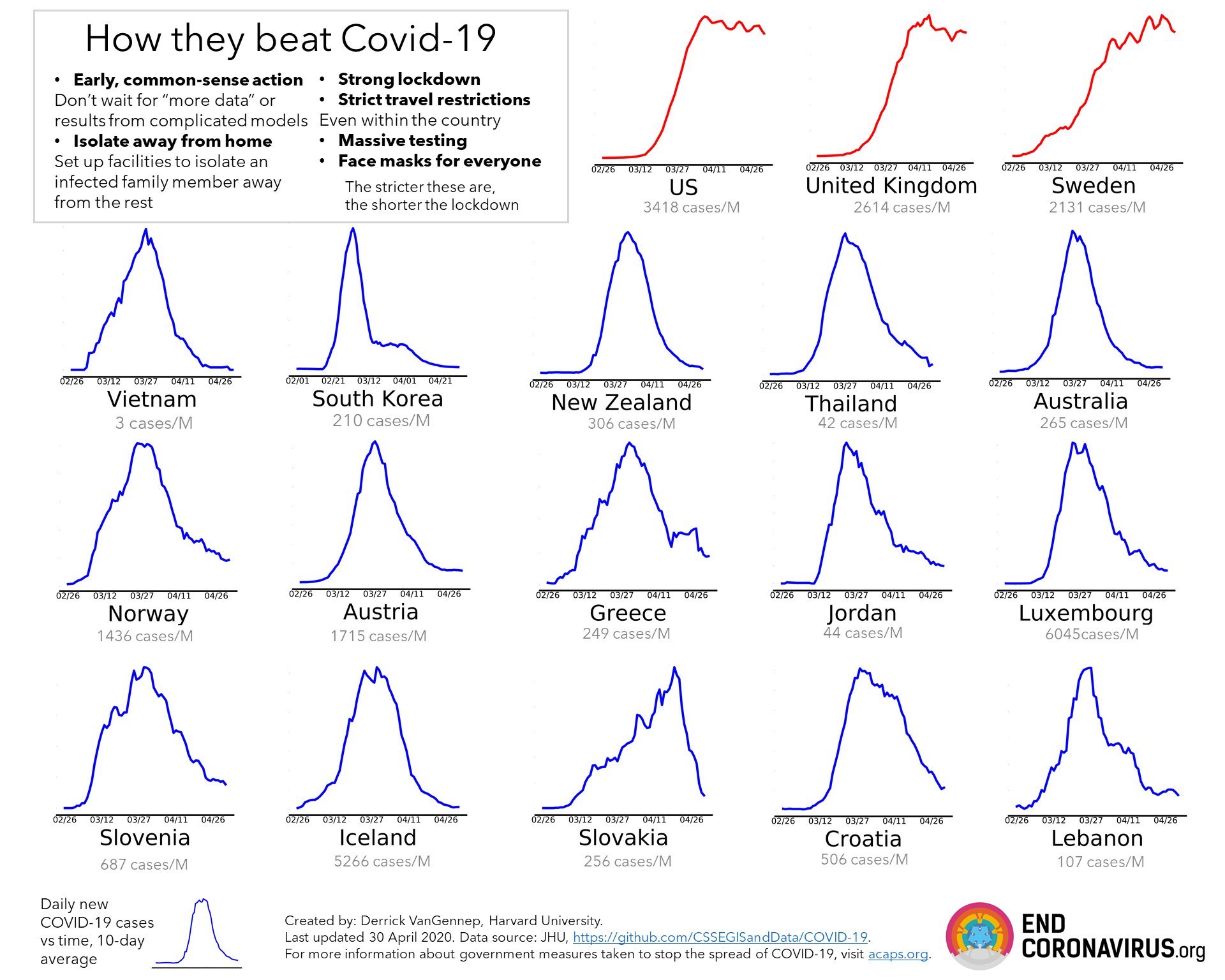
In many countries and all US states, some kind of plan for the end of lockdown is forming. The difference is that some places are further along with containing the virus than others. Last month, Wuhan started allowing people out of their homes for limited periods of time since the lockdown began in January. Yesterday, people in Italy were allowed somewhat into public for the first time in 9 weeks. Meanwhile, in the US, there are no indicators that the virus is under control, yet states are planning "reopenings" of extremely non-essential businesses (like recreation, nail salons, etc.) that could put people in close contact and spike cases back up again.
The curve in the US may have flattened, but it's not bending down, which is the other thing we need it to do. COVID-19 cases have remained at roughly the same level for the past month, while in other countries they've been able to decrease. Why? Because other countries enforced very strict lockdowns and restrictions, and made it easier for people to willingly stay home by providing better financial support for those who couldn't work. In the US we've been able to do pretty much what we want, and it's up to individuals how seriously they want to take it, whether they want to wear a mask to protect others, whether they can go longer without visiting a store, if they can keep themselves from congregating in parks on nice days, etc. Other countries did the hard thing and got it over with. Instead, the US will let this drag on and on...
Another interesting consideration is that data has shown that most people were limiting their movements prior to their state implementing an official "lockdown," meaning they already saw what was happening and made their own decision to stay home, the states merely codified it. If businesses "reopen," I think chances are very slim that most people will be patronizing them as they had been before. So reopening things probably won't change much for the economy, but will lead to more people being exposed and becoming sick because if their employer is open, they won't have a choice about staying home. (I've also seen a lot of people in favor of reopening saying things like, "Of course we'll still continue protecting the elderly and at risk." How will that determination be made? Will less healthy people be given doctors' notes and permission to stay home and receive pay or unemployment compensation? How about people who live with someone who is at risk? What about people who can't go back to work without childcare, in areas where schools are closed and camps have been cancelled?)
I'm now imagining a scenario where most of the world gets things under control, while the US becomes this wasteland nobody wants to travel to (or accept travelers from) or do business with, because the virus is running rampant. There's been lots of exciting news in the last few days about promising developments in treatments and vaccines, but I still maintain that the most effective thing we can do for now, and probably for a long time to come, is just remove human hosts from the virus' reach.
 |
| EndCoronavirus.org |
Another interesting consideration is that data has shown that most people were limiting their movements prior to their state implementing an official "lockdown," meaning they already saw what was happening and made their own decision to stay home, the states merely codified it. If businesses "reopen," I think chances are very slim that most people will be patronizing them as they had been before. So reopening things probably won't change much for the economy, but will lead to more people being exposed and becoming sick because if their employer is open, they won't have a choice about staying home. (I've also seen a lot of people in favor of reopening saying things like, "Of course we'll still continue protecting the elderly and at risk." How will that determination be made? Will less healthy people be given doctors' notes and permission to stay home and receive pay or unemployment compensation? How about people who live with someone who is at risk? What about people who can't go back to work without childcare, in areas where schools are closed and camps have been cancelled?)
I'm now imagining a scenario where most of the world gets things under control, while the US becomes this wasteland nobody wants to travel to (or accept travelers from) or do business with, because the virus is running rampant. There's been lots of exciting news in the last few days about promising developments in treatments and vaccines, but I still maintain that the most effective thing we can do for now, and probably for a long time to come, is just remove human hosts from the virus' reach.
Friday, May 1, 2020
Are You Serious?
Actual question for whoever is reading this: are you being serious about social distancing? Since we officially went into lockdown nine weeks ago, I've been inside a building other than my house just 3 times (for grocery shopping), and otherwise have gotten everything I need via contactless pickup or delivery. I have visited two people in person: my grandmother through a window, and a friend from across her yard. I've stayed home so much, my car battery died. However, I'm seeing lots of people, including my smart, responsible friends, starting to ease up - traveling to visit a grandparent, having dinner with friends or family, setting up play dates, planning a golf outing (yes, golf courses here reopened today, though with restrictions). I wouldn't even get takeout food that I couldn't take out of its containers reheat myself, yet I see people going out for ice cream that they eat directly from the styrofoam cup in which it was served.
I know that at this point we've all (hopefully) been isolating, and so technically we could assume we're not sick and it's safe to gather with other people who've also been isolating. But really, I wouldn't trust that. People are still going to the store, getting deliveries, bringing in mail, jogging past each other... Or maybe someone else in the household is working in an essential field, or had a doctor's appointment. I bet some of them picked up something along the way, and even though there's a very slim chance for everything to line up just right, it's possible. I wouldn't risk it.
Speaking of easing restrictions, that site I like, CovidActNow.org, has changed formats and is now modeling when it will be safe to reopen states and counties, based on 1) if active cases are decreasing (you want an infection rate less than 1, i.e. each person is infecting fewer than 1 other person), 2) if the rate of positive tests is decreasing (this indicates that there is enough testing capacity that they're checking more than just the obvious cases), and 3) if there's enough hospital ICU capacity for a new wave of infections. These align with the criteria my governor announced for our reopening plan, as far as having capacity to monitor and deal with any further outbreaks. Georgia has already "reopened," and they're not doing well in any of those categories. My state has a low infection rate, but is not good in either of the other two criteria. My "hotspot" county is even worse.
I know that at this point we've all (hopefully) been isolating, and so technically we could assume we're not sick and it's safe to gather with other people who've also been isolating. But really, I wouldn't trust that. People are still going to the store, getting deliveries, bringing in mail, jogging past each other... Or maybe someone else in the household is working in an essential field, or had a doctor's appointment. I bet some of them picked up something along the way, and even though there's a very slim chance for everything to line up just right, it's possible. I wouldn't risk it.
Speaking of easing restrictions, that site I like, CovidActNow.org, has changed formats and is now modeling when it will be safe to reopen states and counties, based on 1) if active cases are decreasing (you want an infection rate less than 1, i.e. each person is infecting fewer than 1 other person), 2) if the rate of positive tests is decreasing (this indicates that there is enough testing capacity that they're checking more than just the obvious cases), and 3) if there's enough hospital ICU capacity for a new wave of infections. These align with the criteria my governor announced for our reopening plan, as far as having capacity to monitor and deal with any further outbreaks. Georgia has already "reopened," and they're not doing well in any of those categories. My state has a low infection rate, but is not good in either of the other two criteria. My "hotspot" county is even worse.
Subscribe to:
Posts (Atom)